
The earliest signs of autism in a 2-year-old often include:
- Limited eye contact
- Not responding to their name
- Delayed or lost speech
- Reduced pointing or sharing of interests
- Repetitive behaviors (such as hand-flapping or intense focus on specific objects)
These signs can affect how a child communicates, connects socially, and responds to their environment.
Recognizing these early signs of autism in toddlers doesn’t mean something is “wrong.” It means your child may need support—and the earlier that support begins, the better the outcomes can be.
Signs of Autism in a 2-Year-Old: What the Research Shows
Beyond what parents notice day to day, research also highlights patterns that can help identify autism earlier.
By age two, most children show clear patterns in how they communicate, play, and interact. Clinical research consistently shows that differences in social communication—not just speech delays—are often the earliest and most reliable indicators of autism.
Social Communication Differences
One of the most studied areas in autism research is joint attention—a child’s ability to share focus with another person.
- A typically developing toddler will look where you point or point to show you something interesting
- A child with autism may not follow your gaze or rarely point to share experiences
According to a clinical study in Frontiers in Pediatrics, reduced initiation of joint attention (IJA)—such as not pointing to show excitement—is a strong early predictor of autism.
You might notice:
- Your child doesn’t bring toys to show you
- They don’t look back and forth between you and an object
- They seem less interested in shared experiences
This is one of the most meaningful signs of autism in a 2-year-old, especially when combined with other behaviors.
Limited Response to Their Name
Most children respond to their name consistently by 9–12 months. By age two, this should be well established.
Research shows that a persistent lack of response to name between 12 and 24 months carries high predictive value for autism.
At home, this may look like:
- You call their name multiple times with no reaction
- They respond inconsistently or only when prompted physically
- They seem “in their own world,” even when you’re nearby
Parents often describe this as “it feels like they don’t hear me”—even when hearing is normal.
Eye Contact That Feels Different
Eye contact isn’t just about looking—it’s about connection.
A toddler without autism typically uses eye contact to:
- Share emotions
- Check your reaction
- Engage in back-and-forth interaction
Children with autism may:
- Avoid eye contact
- Briefly glance but not sustain it
- Focus more on objects than faces
Reduced eye fixation can be an early marker of autism, often noticeable before age two.
Early Signs of Autism in Toddlers: Behavior Patterns to Watch
Beyond social communication, autism also involves restricted and repetitive behaviors. These can become more visible around age two.
Repetitive Movements or Play
Some repetitive behaviors are typical in toddlers. But in autism, they tend to be more frequent, intense, or rigid.
You might see:
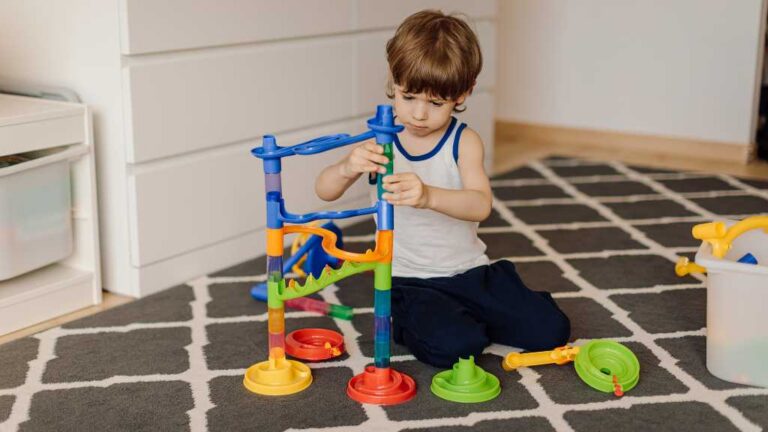
- Hand-flapping, rocking, or spinning
- Lining up toys instead of playing with them
- Fixation on parts of objects (like spinning wheels)
These behaviors often increase during stress or excitement, which aligns with clinical observations of stereotyped motor movements.
Strong Need for Routine
Many toddlers like routines. But children with autism may show extreme distress with small changes.
Examples include:
- Meltdowns or becoming very upset when routines change
- Rigid rituals (same route, same order, same objects)
- Difficulty transitioning between activities
Research describes this as inflexible behavior patterns, reflecting a need for predictability.
Sensory Sensitivities
Some children with autism experience the world more intensely— or in a less heightened way.
You might notice:
- Covering ears to everyday sounds
- Avoiding certain textures (foods, clothing)
- Seeking unusual sensory input (spinning, crashing)
Studies show these can present as hyper- or hypo-reactivity to sensory input, a core feature of autism.
How to Tell if a 2-Year-Old Has Autism vs. a Speech Delay
This is one of the most common questions parents ask:
“Is it just a speech delay—or something more?”
A speech delay alone usually looks like:
- Limited words, but strong eye contact
- Attempts to communicate (gestures, pointing)
- Interest in people and interaction
Autism, on the other hand, often includes:
- Delayed speech plus reduced social engagement
- Limited gestures (pointing, waving)
- Less interest in sharing attention
Research by Frontiers in Pediatrics shows that language delay alone is less predictive of autism, which is why it sometimes leads to later diagnosis.
Does My 2-Year-Old Have Autism? What Parents Notice First
Parents are often the first to recognize differences—and research supports that instinct.
According to clinical data:
- Poor eye contact (51.5%) is one of the most common first concerns
- Language delay (45.5%) often raises early questions
- Repetitive behaviors (~50%) are frequently noticed later
Signs such as a lack of response to name and loss of previously acquired skills (regression) may prompt earlier evaluation, especially when clearly noticed by caregivers.
If you’ve been wondering, “Does my 2-year-old have autism?”, your observations matter. They are often the starting point for getting answers.
Subtle Signs Parents Sometimes Miss
Some signs are easy to notice early, while others are more subtle—especially in busy, everyday moments.
Signs of autism in a 2-year-old that parents can miss may include:
- Preferring objects over people
- Not imitating actions (like clapping or waving)
- Gradual loss of previously learned skills (regression)
Research by the International Journal of Clinical and Health Psychology on early trajectories shows that some children experience motor or communication regression between 18 and 24 months, which can be an important signal.

What to Do Next If You Notice Signs of Autism in a 2-Year-Old
If this list feels familiar, you don’t need to wait.
Step 1: Take a Screening Tool
You can start with a validated screening, such as the Autism Speaks screening tool or the ABA Centers of America autism quiz.
This won’t diagnose autism—but it helps identify risk.
Step 2: Seek a Professional Evaluation
A comprehensive evaluation looks at:
- Social communication
- Behavior patterns
- Developmental history
Early diagnosis leads to earlier support—and research consistently shows that early intervention improves outcomes.
Step 3: Start Early Intervention Right Away
This is where many families get stuck—long waitlists.
At ABA Centers of America, families can access:
- Autism diagnostic evaluations without long delays
- Early intervention programs tailored for toddlers
- ABA therapy focused on building communication and daily living skills
The goal is to help children with autism communicate, connect, and navigate the world with more confidence.
Why Early Support Changes Everything
Brain development in the first three years is rapid. During this window, intervention can significantly improve:
- Language development
- Social engagement
- Adaptive skills
Research across multiple studies confirms that earlier support leads to better long-term outcomes.
That’s why recognizing signs of autism in a 2-year-old matters so much.